
 Rhododendron History
Rhododendron History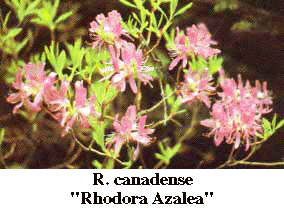 The first rhododendron to be classified and named
was R. hirsutum. It was discovered by the 16th century Flemish botanist, Charles
l'Ecluse, who later became called Clusius. When it was introduced to Britain in
1656 from the European Alps, R. hirsutum (the Alpine Rose) was the first species
of rhododendron in cultivation. Exploration in America came as a result of a
partnership between English Quaker Peter Collinson and botanist/farmer John
Bartram of Pennsylvania. This led to the importation to England of the American
natives, R. canescens, R. nudiflorum, and R. viscosum in 1734, and in 1736 R.
maximum. R. ferrugineum, another species from the European Alps also called the
Alpine Rose, came along in 1752. The two plants called the Alpine Rose are
perhaps the only rhododendron to do well in limestone soils. Claes Alstoemer
discovered R. ponticum in Spain between Cadiz and Gibraltar around 1750 and it
reached England in 1763.
The first rhododendron to be classified and named
was R. hirsutum. It was discovered by the 16th century Flemish botanist, Charles
l'Ecluse, who later became called Clusius. When it was introduced to Britain in
1656 from the European Alps, R. hirsutum (the Alpine Rose) was the first species
of rhododendron in cultivation. Exploration in America came as a result of a
partnership between English Quaker Peter Collinson and botanist/farmer John
Bartram of Pennsylvania. This led to the importation to England of the American
natives, R. canescens, R. nudiflorum, and R. viscosum in 1734, and in 1736 R.
maximum. R. ferrugineum, another species from the European Alps also called the
Alpine Rose, came along in 1752. The two plants called the Alpine Rose are
perhaps the only rhododendron to do well in limestone soils. Claes Alstoemer
discovered R. ponticum in Spain between Cadiz and Gibraltar around 1750 and it
reached England in 1763.
Linnaeus brought order to a hodge podge of names when he established the genus Rhododendron in his book published in 1753. He included 9 species including 6 species of Azaleas which he place in a separate genus.
The German naturalist Pallas described three rhododendron species native to eastern Europe and to Asia: R. dauricum in 1780, R. flavum in 1793, and R. chrysanthum in 1796.
By 1800 there were only twelve species known in cultivation. Gifts from the
Russian collector, Count Pushkin, R. caucasicum and R. obtusum arrived in
England in 1803 and R. minus came from America in the first few years of the new
century.
| Fraser, John (1750-1811) A scotsman, John Fraser started business in London as a linen-draper near the Chelea Physick Garden. He gave up his business to become a plant collector. He crossed the Atlantic many times and some of our best known shrubs were introduced by him. Among these were Magnolia fraserii, Rhododendron catawbiense and Pieris floribunda. |
 In 1809 R. catawbiense was introduced from North
Carolina. It later became the principal source of hardiness in the garden
hybrids which have graced our gardens for generations. It was collected by John
Fraser and his son while collecting plants for Russian Emperor Paul.
In 1809 R. catawbiense was introduced from North
Carolina. It later became the principal source of hardiness in the garden
hybrids which have graced our gardens for generations. It was collected by John
Fraser and his son while collecting plants for Russian Emperor Paul.
The first of many Rhododendrons which were to come from southeastern Asia was
the tree species, R. arboreum, with blood-red flowers, which was discovered by
Captain Hardwicke in 1799 and arrived from India in 1811. In 1823 R. molle,
destined to become famous as one of the parents of the Mollis hybrids, was
introduced from China. In 1832 R. zeylanicum came into England from Ceylon. From
the Himalayan regions of Nepal and Sikkim, R. campanulatum was introduced in
1825 and the beautiful R. barbatum was introduced in 1849.
| Hooker, Sir Joseph D.(1817-1911) Son of Sir William, who he succeed as Director of Kew Gardens [http://www.sisley.co.uk/kew.htm]. Sir Joseph Hooker returned from the Himalayas in 1850 with the magnificent Sikkim rhododendrons. He introduced the Himalayan birch and reported amongst other trees, the biggest of all magnolias, Magnolia Campbellii. |
In 1849 and 1850 Sir Joseph Hooker's expedition to Sikkim in the eastern Himalayas discovered forty-five new species including the yellow-flowered R. campylocarpum and R. wightii; the red-flowered R. thomsonii; the small trees, R. falconeri, R. grande, and R. hodgsonii, with their enormous leaves; the epiphytes, R. dalhousiae and R. maddenii; the large vigorous R. griffithianum with massive white flowers; and the interesting R. triflorum, R. edgeworthii, R. fulgens, R. niveum, R. wallichii, R. lanatum, R. glaucophyllum, R. cinnabarinum, and R. lepidotum. Booth found R. hookeri and R. nuttalli in Bhutan in 1852.
| Robert Fortune (1812-1880) [http://www.gardenweb.com/cyberplt/people/fortune.html] Robert Fortune was born in Scotland in 1812 and in 1842 he was Deputy Superintendent of the Horticultural Society's garden at Chiswick in England. China was a country closed to all foreigners, with the exception of French Jesuit missionaries. These missionaries sent small quantities of seed back to Europe, along with reports of many wonderful plants unknown in the west. The Treaty of Nanking ended the first Opium War in 1842 and granted England the right of entry to the interior. The Horticultural Society chose Fortune to lead its first expedition even although Fortune had no experience of collecting or the Chinese language. This 1843 expedition had limited success as the country was still in turmoil and access was still restricted to the coastal areas. Fortune not only brought back new plants but also new techniques including the art of bonsai. Fortune returned to China on several occasions and collected material from a country still in upheaval with a succession of Opium Wars. It was only later that the large collections were made by Forrest, Kingdom-Ward and Wilson. |
In 1855 Robert Fortune discovered R. ovatum in 1854 and R. fortunei in 1855 in Chekiang, China. It became the foundation of an important series of hybrids hardy in the United States as far north as Boston.
The next wave of exploration in 1881 was the outcome of the discoveries of French Catholic missionaries, Pere Armand David, Pere Jean Marie Delavay and Farges whose discovered were name R. davidii, R. delavayi, R. fargesii, and R. souliei. David also discovered R. calophytum. Delavay also discovered R. ciliicalyx, R. fictolacteum, R. lacteum, R. neriiflorum, and R. campylogynum in 1884; R. crassum and R. haematodes in 1885; R. bullatum, R. irroratum, and R. heliolepis in 1886; R. sulfureum in 1887; and R. racemosum, R. spinuliferum,and R. rubiginosum and R. yunnanense in 1889; all in Yunnan, China. Farges also discovered R. adenopodum at 6,000 feet elevation in Szechuan/Hupeh, China. Rev. Souliei discovered R. chasmanthum and R. vernicosum in 1893, R. saluense in 1894, and R. wardii in 1895, in Yunnan, China. Rev. Ernest Faber discovered R. concinnum in Yunnan, China, in 1886. Many of these plants were grown from seed and introduced by Forrest.
In 1885 Baron Ungern-Sternberg discovered R. smirnowii and R. ungernii in the Caucasus Mountains.
| Ernest Henry Wilson (1876-1930) Wilson [http://www.gardenweb.com/cyberplt/people/wilson.html] was born in Chipping Campden, England in 1876, 33 years after Robert Fortunes first Chinese expedition. In 1897 he obtained a position at Kew. In 1898 the Managing Director of the famous Victorian Veitch Nurseries asked the Director at Kew to recommend a young man to travel to China to find a source of The Handkerchief Tree--Davidia involucrata. Wilson was recommended. The first trip lasted for three years. Wilson found not only the Davidia in the mountains of Northwestern China but 400 additional new plants. Subsequently he found many new rhododendron, roses, primula and Meconopsis. Such was Wilson's reputation that in 1906 his ties with Veitch were severed and he was recruited by the Arnold Arboretum in Boston, Massachusetts. The Director of the Arboretum at that time, Professor Charles Sprague Sargent, used Wilson's talents all over the world in search of new species for the Arboretum--Japan, Korea, Australia, New Zealand, India, Africa and, of course, China. Wilson was estimated to have introduced 2000 new species in a four month period and much of the original material collected by Wilson can be seen at the Arnold Arboretum. |
 The discoveries by the French missionaries led to
a systematic search stated in 1899 and followed up in 1903-4 by Dr. Ernest Wilson
for plants in China. Wilson found R. discolor, R. praevernum and R. ponticum
in 1900; R. micranthum and R. sutchuenense in 1901; and R. ambiguum, R.
intricatum, R. longesquamatum, R. obiculare, R. oreodoxa, R. tricanthum, R.
wasonii, and R. davidsonianum in 1904 in Szechuan, China. Wilson introduced R.
insigne and R. williamsianum in 1908 and R. moupinense in 1909.
The discoveries by the French missionaries led to
a systematic search stated in 1899 and followed up in 1903-4 by Dr. Ernest Wilson
for plants in China. Wilson found R. discolor, R. praevernum and R. ponticum
in 1900; R. micranthum and R. sutchuenense in 1901; and R. ambiguum, R.
intricatum, R. longesquamatum, R. obiculare, R. oreodoxa, R. tricanthum, R.
wasonii, and R. davidsonianum in 1904 in Szechuan, China. Wilson introduced R.
insigne and R. williamsianum in 1908 and R. moupinense in 1909.
Wilson's work lead to a flood of expeditions by plant exporers to Asia. In
1904 George Forrest and Reginald Farrer explored Yunnan, China. Forrest
discovered R. haemaleum and R. strigillosum in 1904; R. forrestii in 1905; R.
oreotrephes in 1906; R. fulvum and R. sinogrande in 1912; R. puralbum, R.
scintillans, and R. russatum in 1913; R. griersonianum and R. meddianum in 1917;
R. keleticum and R. scyphocalyx in 1919; and R. taggianum in 1925. Forrest's and
Farrer's work was carried on by Captain F. Kingdon-Ward in 1911, and Dr. Joseph
F. Rock in 1920, the partners Ludlow and Sheriff and others. Kingdon-Ward
discovered R. chryseum at 13,000 feet in Yunnan, China, in 1912; R.
hippophaeoides at 12,000 feet in Yunnan, China, in 1913; R. megacalyx at 8,000
feet and R. calostrotum at 11,000 feet in Burma in 1914; R. leucaspis and R.
valentinianum at 11,000 in Yunnan, China; R. pemakoense in Tibet in 1924 and R.
recurvoides in July 1926 in the valley of the Di Chu in Upper Burma. Farrer and
Kingdon-Ward discovered R. aperantum which was introduced by Forrest. Farrer
discovered R.sperabile in Tibet in 1919. Forrest found and introduced R.
stewartianum in Yunnan, China, in 1904; R. impeditum in Yunnan, China, in 1911;
R. diaprepes in Yunnan, China, in 1913; R. eriogynum in Yunnan, China, in 1914;
and R. didymum, R. eclecteum and R. eudoxum in Tibet in 1917. Farrer discovered
R. caloxanthum in the Tibet/Yunnan region in 1919 and R. tephropeplum in Burma
in 1920. From seed collected by Kingdon-Ward was identified two new species, R.
concatenans and R. xanthocodon.
| Forrest, George (1873-1932) George Forrest [http://www.gardenweb.com/cyberplt/people/forrest.html] was the greatest of all collectors of rhododendrons, introducing hundreds of species from China and Tibet to Edinburgh Botanic Garden, including R.giganteum and R.sinogrande. Sponsored by the seedsman, A.K.Bulley of Ness, he went to China in 1904. He also specialized in primulas. The list of material collected by Forrest is impressive and includes Abies georgei, Abies forrestii (a beautiful silver fir), Acer forrestii (snakebark maple), Adenophera, Aster, Dacocephalum, Hemerocallis, Iris, Primula and Rhododendron forrestii. |
Meanwhile Dr. Augustine Henry, a medical officer, discovered R. augustinii in Szechuan, China, and R. racemosum was discovered by Delavay in Yunnan, China, in 1889. R. griersonianum and R. arizelum were discovered by Geroge Forest in 1917 at about 10,000 feet elevation in Yunnan, China.
| Aberconway, Henry Duncan, 2nd Baron (1879-1953) Encouraged by his mother, Laura, the first Lady Aberconway, the Second Baron Aberconway developed the magnificent gardens of Bodnant [http://www.sisley.co.uk/bodnant.htm] in North Wales over 50 years from 1901. Assisted over most of this time, as head gardeners, by three successive generations of the Puddle family. Lord Aberconway subscribed to many plant hunting expeditions and hybridized rhododendrons and other plants, many of which have gained worldwide fame. |
In 1937, R. aberconwayi was grown from seed from eastern Yunnan sent by Chinese assistants of George Forest to Lord Aberconway after Forest's death in 1932.
| Ward, Frank Kingdon (1885-1958) Frank Kingdon Ward [http://www.geocities.com/tooleywatkins/fkwbiog1.html] traveled widely in the Himalayas and published several readable accounts of his experiences in the 1920s including The Riddle of the Tsangpo Gorges and The Romance of Plant Hunting. He collected unusual primulas, lilies, rhododendrons and gentians. He studied the distribution of the Meconopsis in Tibet. |
Most rhododendron species, over 900, are found in Southeast Asia, ranging from the Himalayas through Tibet, Burma, China, Thailand, Viet Nam, to Malaysia, Indonesia, Philippines and New Guinea. The distribution of native species extends down to northern Australia, up to Siberia, and around the world. Europe has 4 species, and in North America about 28 species are found.
| Ludlow, Frank (1895-1972) With George Sherriff, Frank Ludlow is well known for his discovery of rhododendrons and primulas on expeditions to Tibet. |
Other recent discoveries of new species include the giant
yellow flowered R. sinofalconeri, the red species from the Yunnan/Sichuan border
R. ochraceum, and the pink dwarf species R. dendrocharis. And more recently
Kenneth Cox led an expedition to Tibet that discovered R. bulu and R.
dignabile.
R.
calendulaceum, the Flame Azalea, is a tall deciduous azalea found from
southwest Pennsylvania south through the Appalachian Mountains to Georgia and
Alabama and west to West Virginia and southeastern Ohio. Its flowers vary from
red to orange to yellow.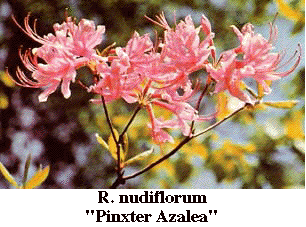
R. canadense, Rhodora Azalea, is a low deciduous azalea found from Eastern Quebec to Newfoundland and Nova Scotia, and south the northern parts of Pennsylvania and New Jersey. It has showy lavender flowers.
R. canescens, Florida Pinxter- flower, is often confused with R. periclymenoides. Both occur in the Carolinas but can be separated by the flower tubes, which in R. periclymenoides are fuzzy. R. canescens also has tiny hairs, but they are sticky and glandular. Another noticeable difference is that when a flower of R. periclymenoides dies, a ridge on the corolla tube tends to catch on the end of the pistil so that a flower cluster past its prime consists of several dangling blossoms. Although widespread in the eastern half of the U.S., these two wild azaleas differ in distribution. In South Carolina, for example, R. periclymenoides is a Piedmont plant, with almost no specimens reported from the Sandhills or Coastal plain, while R. canescens is predominantly a Low Country plant absent from the Piedmont, except in counties that border the Savannah River. In general, if it grows wild north of South Carolina, it's likely R. periclymenoides; south of the Palmetto State and it's probably R. canescens. Both species prefer moist, humus-laden, acidic soil but seem to do equally well in shade or sun. Old specimens can reach heights of 12-15 feet and have multiple stems or trunks up to 5" in
R. catawbiense, Mountain Rosebay, is a medium to tall rhododendron native from Virginia south to Georgia and west to Alabama, Kentucky and West Virginia. It has large rose to purple-lilac colored flowers.
R. lapponicum, Lapland Rosebay, is a very low rhododendron is found from Maine to Wisconsin and north from Quebec to Newfoundland. It has clusters of pink to lavender flowers. It is found on mountain tops and in sub arctic areas.
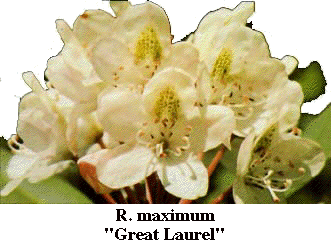
R. maximum, Great Laurel, is a large rhododendron ranging from Maine to Georgia and west to Alabama and Ohio. This tall straggly plant has pinkish-white flowers.
R. periclymenoides, formerly R. nudiflorum, the Pinxterbloom Azalea, is a medium deciduous azalea found from Massachusetts south to South Carolina and west to Tennessee and Ohio. It has showy pinkish-white flowers. Pinxter-flower, with lightly fragrant inch-wide blooms, is perhaps the most common and most familiar wild azalea in the eastern U.S. The name "pinxter" comes not from its coloration but from the Dutch words Pinxter blomachee, which relate to the fact that this is supposedly the azalea that blossoms on Pentecost, 50 days past Easter. We suspect this name was given by folks in northern parts of the plant's range, since in the Carolinas it is more likely to be in bloom for Easter Sunday itself.
R occidentale, Western Azalea, is a tall deciduous azalea found in the Pacific Coast states. The flower color is usually white or pale pink with a strong yellow flare, but my be red, yellow or orange-pink and occasionally the flare is maroon. The foliage turns red and copper shades in the fall. It is difficult to grow on the East Coast.
R prunifolium, Plumleaf Azalea, is a medium deciduous azalea found in the Southeast United States. The color ranges from orange-red to red, and occasionally orange or yellow. This species blooms very late, usually in late June or in July. It prefers more shade than most deciduous azaleas.
R. viscosum, Swamp Honeysuckle, is a medium deciduous azalea found
from Maine to Georgia and west to Texas. It has fragrant white flowers.
 The Rhododendron &
Azalea Bookstore
The Rhododendron &
Azalea Bookstore